
If you’ve seen the videos — kilometre-long queues snaking out of petrol pumps in Hazratganj, “No Stock” boards going up all across Gomti Nagar, PAC personnel deployed at fuel stations — you’re probably wondering how bad things actually are. The answer is complicated, and the full picture looks very different depending on which part of it you’re staring at.
What Triggered the Petrol Crisis in Lucknow?
The chaos didn’t come from an empty pipeline. It came from a WhatsApp forward.
A wave of panic buying hit petrol pumps across several Indian cities after viral social media messages falsely claimed an imminent fuel shortage linked to the ongoing West Asia conflict. These messages — many of them completely unverified — suggested that the Strait of Hormuz crisis would cut India off from oil supplies, and that either a massive price hike or a government-imposed lockdown was just around the corner.
Finance Minister Nirmala Sitharaman and Petroleum Minister Hardeep Singh Puri both dismissed social media speculation suggesting that the government was planning to restrict movement to conserve fuel, with Sitharaman stating, “I want to reassure the public that there shall be no lockdown. These reports are completely baseless.”
But by the time that clarification came, the damage to public confidence was already done. People who normally buy 2 litres at a time were demanding full tanks. Some were even pulling out external jerry cans and bottles to store fuel at home.
What Actually Happened at Lucknow’s Petrol Pumps?
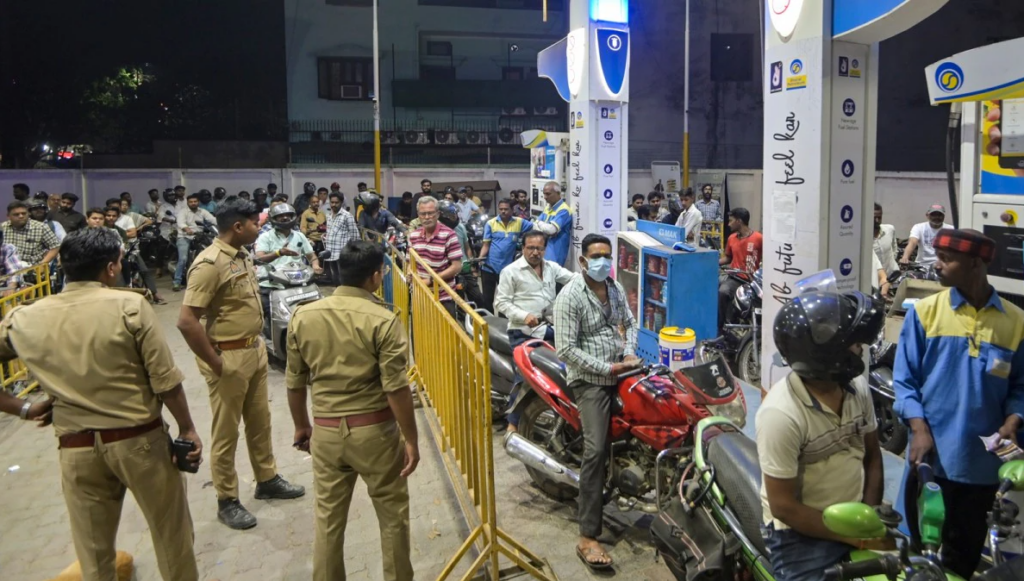
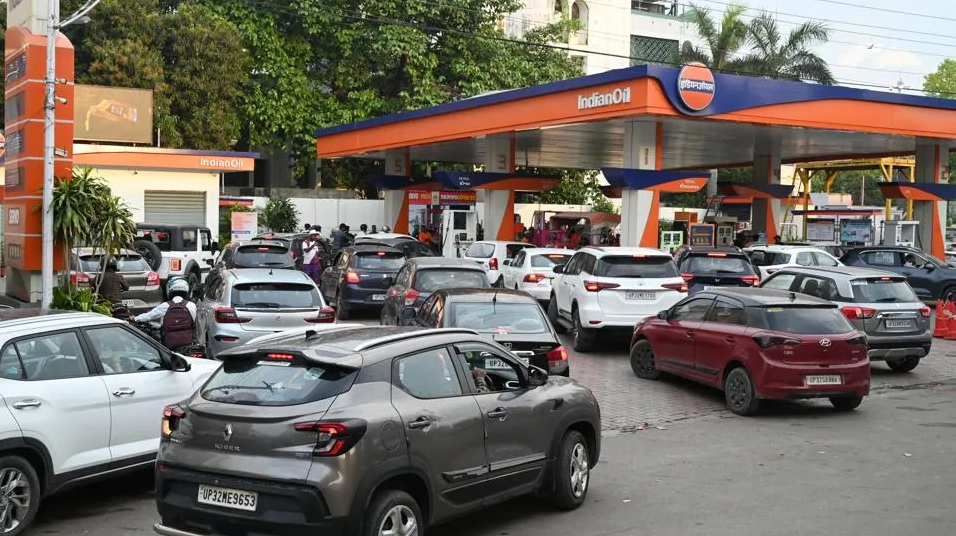
On the ground, it got messy — fast. Stations in areas like Hazratganj, Gomti Nagar, and near Civil Hospital saw queues stretching hundreds of metres. At the Capital Petrol Pump in Hazratganj, the crowd grew so large that PAC personnel had to be deployed to maintain order. Delivery workers reported visiting 8–10 stations in one go without success. Bank field officers who travel to places like Sitapur complained about the ₹200 limit that several pumps imposed on bikes — not nearly enough for a long-distance work trip.
In Lucknow, state oil industry coordinator Sanjay Bhandari appealed to the public to avoid hoarding, reiterating that there was no actual shortage, only a temporary mismatch between demand and supply caused by panic buying.
The numbers back this up. Lucknow DM Visakh G Iyer confirmed that demand at petrol pumps in the district had jumped by roughly 30–35% in a single day — that alone is enough to drain a pump that gets refilled on a normal schedule. When panic buying pushes daily consumption to 141% above normal for petrol and over 107% for diesel, even a well-stocked station goes dry before the tanker shows up. That’s not a shortage. That’s a delivery bottleneck created entirely by the rush.
So Is There Actually Any Fuel or Not?
Yes — and this is the part that gets buried under the panic headlines. The Ministry of Petroleum and Natural Gas stated that all retail outlets are operating normally across the country, that adequate stocks of petrol and diesel are available at all petrol pumps, and that all refineries are operating at high capacity with adequate crude inventories in place.
UP officials have confirmed that the state has 20–22 days of fuel stock sitting in reserves. That’s a meaningful buffer. Indian Oil Corporation said there is “no shortage of petrol or diesel” and that its outlets are well-stocked and fully operational, while BPCL stated that India is actually a net exporter of petrol and diesel.
Officials said that citizens need not queue at petrol pumps, as fuel will be available whenever required, adding that the system is robust enough to meet demand — provided it remains rational.
Petrol in Lucknow is currently priced at ₹94.69 per litre — that hasn’t shot up dramatically either. There’s no overnight price hike, no ration card required at the pump. The price is what it was.
Then Why Did So Many Pumps Show “No Fuel” Boards?
This is where the self-fulfilling prophecy of panic buying gets painfully obvious. The irony is that the shortage people feared began to appear only after panic buying intensified — fuel sales in several regions surged to 2.5 to 3 times normal levels, leading to temporary stock exhaustion at retail outlets.
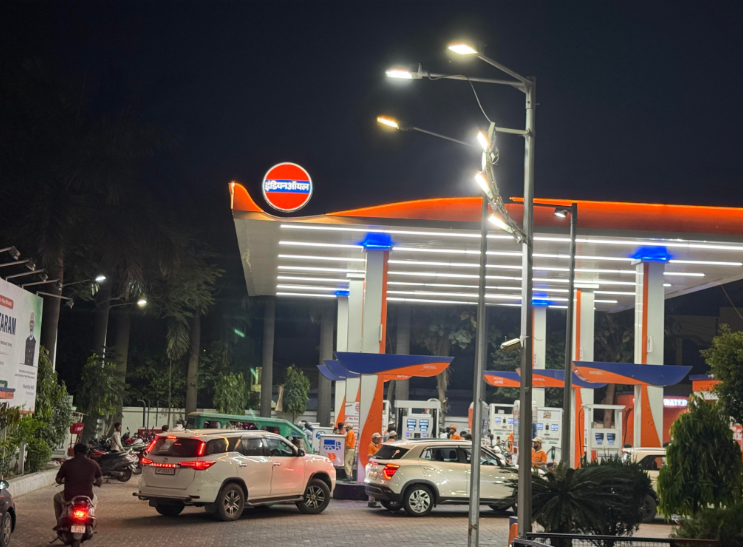
Pump managers explained that their daily consumption of 22,000–25,000 litres doubled within 48 hours. Fuel must arrive via specialised tankers that follow strict safety protocols — you can’t just speed up that pipeline on a Tuesday afternoon because half the city suddenly decided to fill up. So the “No Stock” boards you saw? They reflected temporary depletion from an artificial rush, not a broken supply chain.
Officials said the biggest threat to fuel availability right now is panic buying itself — when consumers rush to stock up simultaneously, pumps can temporarily run dry even when supplies remain stable.
By March 28, the situation in areas like Gomti Nagar had already started stabilising. “No Fuel” boards were coming down, queue lengths had shrunk, and restrictions on fuel amounts were being lifted as tanker deliveries caught up with the demand.
The LPG Crisis Is a Different Story — And It Made Everything Worse
One thing that genuinely is in short supply right now is LPG cooking gas — and that’s been feeding the fear around petrol too.
The deepening shortage of LPG in Lucknow has crippled small business owners and migrant workers, with many labourers and street vendors being forced to shut down their operations and return to their home districts. Cylinder booking gaps have stretched from 25 days to 35 days for urban households, and up to 45 days in rural UP. Cylinders are reportedly showing up on the black market for ₹2,000–₹3,000 — two to three times the official price. Workers in Indira Nagar, Nishatganj, Chowk, and Gomti Nagar have all shared stories of going without gas for over a week.
The LPG crunch is real, confirmed, and rooted in the global disruption of shipping routes through the Strait of Hormuz. When Lucknow residents — already struggling to get cooking gas — started seeing WhatsApp messages about petrol running out next, the collective anxiety tipped into full panic mode. The two crises fed each other, even though they’re very different in nature.
The government has since been accelerating PNG (piped gas) connections as a long-term fix and has raised commercial LPG supply quotas to ease pressure on industries.
What the Government Has Done?
By March 27–28, the administration moved on multiple fronts. Lucknow DM Visakh G Iyer said a meeting was held with oil marketing companies as soon as the surge was detected, and that police and the administration were ensuring no pump faced a prolonged outage.
CM Yogi Adityanath ordered a crackdown on rumour-mongers spreading misinformation about fuel shortages and directed police to protect pump owners in areas where physical altercations had broken out in the queues. The government also slashed excise duty — petrol by ₹10 per litre and diesel by ₹10 per litre — to signal that prices would not spike on consumers.
The Petroleum Ministry stated that India has expanded its oil import sources from 27 to 41 countries over the last decade, significantly reducing reliance on any single region, and that the country currently holds approximately 60 days of crude oil stocks.
What This Says About Lucknow’s Information Problem?
The most uncomfortable takeaway from all of this is that the city essentially panicked itself into a temporary shortage. One official put it bluntly: “It’s regrettable that when the government speaks, no one listens, but everyone believes the rumours.”
That’s not just a Lucknow problem — the same thing played out in Hyderabad, Ahmedabad, Indore, Prayagraj, and dozens of other cities. But Lucknow, already dealing with a genuine LPG crisis at the same time, was arguably more primed for panic than most. When one fuel source is genuinely unavailable, it’s not a stretch for people to assume the next one might go too.
The lesson from this is painful but clear. In an age where a single viral message can reshape the behaviour of an entire city in hours, the absence of fast, credible official communication is dangerous. The government’s reassurances came too slowly for a panic that spread in real time.
Current Situation (as of March 28, 2026)
Petrol is available in Lucknow. Queues have shortened considerably. The ₹200 bike limits have largely been lifted at most pumps. Petrol in Lucknow is priced at ₹94.69 per litre as of March 27. The LPG situation, however, remains genuinely strained and is expected to take longer to normalise depending on how the Strait of Hormuz situation develops.
FAQs
Is there a petrol shortage in Lucknow right now?
No, not in the technical sense. There’s no supply chain breakdown. What happened was a demand spike caused by panic buying that temporarily drained pumps faster than tankers could refill them. As of March 28, the situation is stabilising.
Why were so many pumps showing “No Fuel” boards?
Because panic buying pushed daily consumption to over 141% above normal in some areas. When 22,000–25,000 litres gets consumed in a few hours instead of a full day, even a well-stocked pump runs dry before its next delivery arrives. It’s a delivery timing issue, not a supply issue.
Is the petrol price going up in Lucknow?
As of March 27–28, petrol in Lucknow is at ₹94.69 per litre — it actually trended slightly down this month from ₹95.48 at the start of March. The government has cut excise duty by ₹10 per litre, which is expected to keep retail prices from spiking.
Is the LPG crisis connected to the petrol situation?
They have the same geopolitical root cause — the West Asia conflict and the Strait of Hormuz disruptions — but they’re two separate supply chains. The LPG crisis is real and ongoing. The petrol “crisis” was primarily panic-driven, not a supply failure.
Should I store petrol at home just in case?
Please don’t. Storing fuel in loose containers, bottles, or jerry cans is a serious fire hazard. Authorities have specifically warned against this. With 20–22 days of official state reserves, there’s no rational case for home fuel storage.
Is the situation going to get worse?
That depends on how long the global disruptions last. India has 60 days of crude oil reserves, refineries are at full capacity, and the government has diversified import sources. The bigger risk is another round of social media panic, not an actual supply collapse.
What about the LPG situation — when will it improve?
The government is expanding PNG connections, raising commercial LPG quotas, and securing alternative import routes. But if the Strait of Hormuz remains closed for weeks, the LPG crunch will likely continue to bite — especially for small businesses and migrant workers in Lucknow who have no fallback option.
The petrol situation in Lucknow is a case study in how information — or the lack of it — can create a crisis almost out of thin air. The LPG crisis is real and deserves attention on its own terms. But the petrol pump queues? That was largely Lucknow scaring itself into exactly the situation it was afraid of.